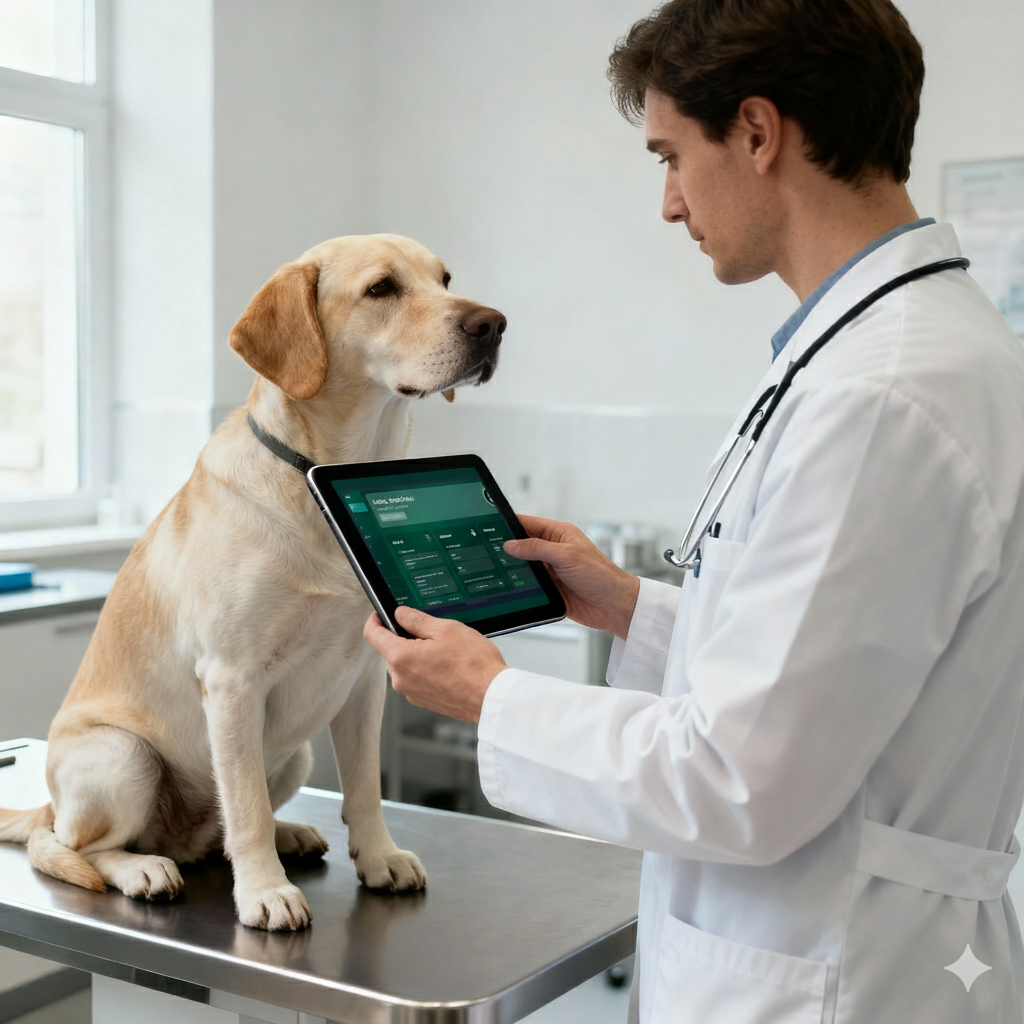
AI is helping vets save time and improve care. See the tools and workflows that make clinics faster and more accurate with VettConsult and others.
Veterinary professionals around the world continue to face increasing workloads, long documentation hours, and the constant challenge of balancing care quality with operational demands. The promise of AI is no longer futuristic; it is here, reshaping daily veterinary workflows and helping teams reclaim time for what matters most: patient care.
From automatic SOAP documentation to real-time case insights, artificial intelligence is creating measurable impact across clinics of every size. Below, we explore six AI-driven categories that are transforming veterinary efficiency, featuring tools and platforms that integrate directly into practice management systems while maintaining clinical integrity.
The growing challenge of veterinary workload
The average veterinarian spends more than two hours per day documenting cases, reviewing lab data, and completing administrative forms. Practice managers report similar struggles: juggling multiple platforms, disconnected workflows, and fragmented communication.
Adding more software has often made things worse, not better. A growing number of clinics now realize that efficiency requires integration, not just automation. A functional veterinary AI ecosystem in 2025 is cohesive, compliant, and built around real veterinary needs, not generic medical templates.
Each tool highlighted below addresses a distinct part of the workflow, such as documentation, clinical analysis, education, inventory, or communication, and complements rather than competes with the others.
The 2025 AI veterinary stack for a smarter clinic
After analyzing emerging technologies and consulting with clinical teams across North America and Europe, we identified six categories of AI tools that can coexist within one connected ecosystem. Each improves a specific workflow while remaining fully compatible with leading PMS platforms such as Avimark, Cornerstone, Vetspire, and ezyVet.
1. AI Documentation and Workflow Support
Examples: VettConsult SOAPvett, CoVet, Talkatoo
Manual documentation remains one of the largest time drains in clinical practice. AI documentation platforms now capture real-time conversations and automatically generate structured SOAP notes.
SOAPvett by VettConsult enables veterinarians to dictate cases naturally while the system transcribes, summarizes, and organizes them in seconds. Similarly, CoVet and Talkatoo provide speech-to-text transcription designed specifically for veterinary terminology, reducing end-of-day paperwork and improving consistency.
Some platforms go further by summarizing previous records or generating follow-up tasks automatically. By embedding these systems into routine workflow, clinics report saving up to 90 minutes daily, translating into more appointments or earlier finishes.
2. Clinical Decision Support and Diagnostic Assistance
Examples: NALA AI (VettConsult), IDEXX SediVue Dx, Zoetis Vetscan Imagyst
AI has become a reliable partner in diagnostics. Tools like IDEXX SediVue Dx now deliver automated urine sediment analysis with remarkable consistency, while Zoetis Vetscan Imagyst uses deep learning to identify parasites and cell types with near-human accuracy.
Within VettConsult, NALA AI acts as an intelligent clinical assistant that instantly retrieves evidence-based information from thousands of veterinary sources. Veterinarians can ask case-specific questions such as “What are the latest recommendations for feline pancreatitis?” and receive referenced guidance within seconds.
Used responsibly, these systems strengthen clinical judgment rather than replace it, offering rapid insights that improve decision-making and client communication.
3. Workflow Analytics and Case Management
Examples: VettConsult ClinicFlow, Shepherd App, VetRadar
Modern practices generate immense amounts of data including appointments, lab results, communications, and invoices. Yet most of it remains underused. AI-powered workflow analysis tools like ClinicFlow extract meaning from this data, providing concise summaries of referred patients and highlighting priorities through visual timelines.
VetRadar and Shepherd App apply similar principles; they centralize patient information and track real-time case status to improve team coordination. The result is smoother shift transitions, better follow-up tracking, and fewer overlooked details during busy clinic days.
4. Learning and Continuing Education with AI
Examples: GekkoVet, VIN
Knowledge updates are essential for any veterinarian, yet continuing education often requires time that practitioners do not have. Platforms like GekkoVet and VIN (Veterinary Information Network) deliver clinical updates and evidence-based resources instantly.
5. Communication and Collaboration Tools
Examples: VettConsult VetTalk, PetDesk, Weave
Client communication, appointment coordination, and inter-vet collaboration often consume more energy than expected. AI-driven communication platforms are now reducing that burden.
VetTalk, VettConsult’s professional network, allows veterinarians to connect globally, share cases, and receive peer-verified answers within minutes. For client-facing automation, PetDesk and Weave provide appointment reminders, follow-ups, and educational messages, ensuring consistent engagement without overwhelming staff.
These platforms collectively reduce burnout and enhance collaboration, ensuring that both internal teams and clients stay informed efficiently.
6. Inventory and Prescription Automation
Examples: Inventory Ally, Covetrus Rx Management, Vetsource
Stock shortages, over-ordering, and manual prescription coordination are persistent challenges. Inventory Ally and Covetrus Prescription Management use predictive analytics to track usage trends, forecast needs, and automate reorder processes.
These systems learn from each clinic’s patterns such as seasonal vaccine demands or tick season medication surges, and adjust supply strategies accordingly. For prescriptions, Vetsource integrates refill tracking and compliance monitoring, embedding all medication data into the patient’s record automatically.
When paired with documentation tools like SOAPvett, every refill and order syncs with the patient file, ensuring continuity between medical, logistical, and financial workflows.
Real-world outcomes: From fatigue to focus
Clinics adopting integrated AI systems report measurable improvements.
- Time savings: Documentation time reduced by 50 to 70 percent.
- Accuracy: Consistent recordkeeping and fewer missed clinical details.
- Team wellbeing: Lower after-hours workload and reduced compassion fatigue.
- Client satisfaction: Faster communication and clearer reports.
As Dr. Emma Lin from Ontario noted after implementing multiple AI tools, “The goal isn’t replacing the veterinarian; it’s removing everything that prevents us from being one.”
Implementation tips for 2025
Adoption success relies on three key factors:
- Integration first: Choose AI tools compatible with your current PMS to avoid workflow silos.
- Gradual rollout: Start with one domain, usually documentation, before adding diagnostic or communication tools.
- Team training: Ensure every staff member understands the system’s benefits and boundaries, particularly regarding data privacy and clinical oversight.
FAQs: AI in Veterinary Practice
1. Are AI veterinary tools safe for clinical use?
Yes. Veterinary AI tools undergo extensive validation. Their outputs should complement, not replace, clinical judgment.
2. How do these systems integrate with existing practice software?
Most connect through APIs or synchronization layers with popular PMS systems like Cornerstone, Avimark, or Vetspire.
3. Can AI reduce burnout in veterinary teams?
Absolutely. Studies show that reducing administrative load improves job satisfaction and work-life balance without reducing quality of care.
4. How much training is required?
Minimal. Most tools are intuitive, and onboarding typically takes under one week with guided setup.
5. Which areas of veterinary medicine benefit most from AI today?
Documentation, diagnostics, and communication show the strongest measurable gains, but inventory and telehealth are catching up quickly.
The path forward
Veterinary AI is not about replacing expertise, it is about amplifying it. The clinics embracing automation, data-driven insights, and collaborative learning are not just surviving the workload crisis; they are redefining what efficient, compassionate veterinary care looks like.
The future of veterinary medicine is already here. It listens, learns, and supports you, one case at a time.