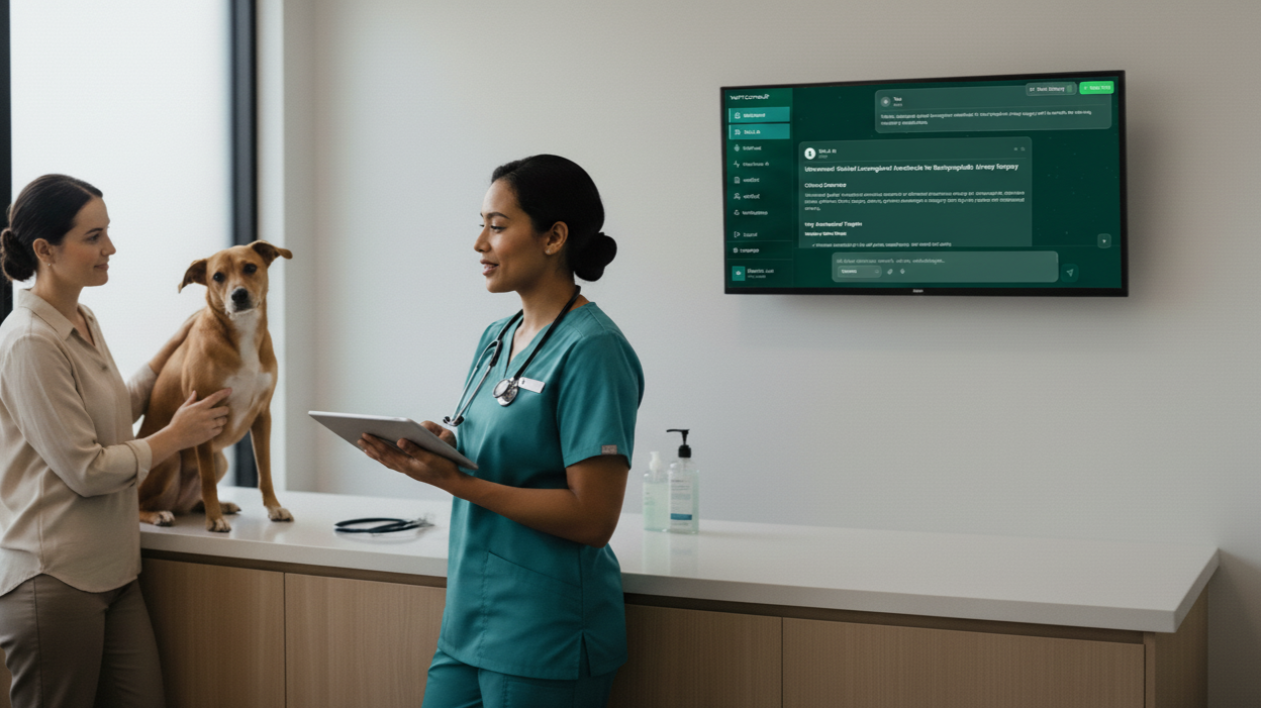
Veterinary burnout: discover how technology and SOAPVett help reclaim time, reduce administrative overload, and restore clinical presence for happier teams.
Introduction: Time, Presence, and the Work You Chose
It is 7:58 a.m. The doors are not open yet, but the day has already started. You log into the PMS, search for last night’s labs, open today’s imaging, return one urgent message, and skim three histories before the first patient arrives. None of this is hands-on medicine, yet it is how most days begin.
Veterinary care is a human craft built on presence. Listening to a worried client, noticing a subtle change in gait, making a call with imperfect information. Presence requires time. Modern clinics leak time in invisible ways. This edition offers a practical, humane guide to finding where the minutes go and getting them back, without asking your team to work faster or care less.
Our goal is not speed. It is less friction, clearer focus, and more medicine.
01. THE SYSTEMIC PROBLEM
Burnout is a Workflow & Systems Problem
Across roles, veterinary teams report high levels of exhaustion. Hospital managers show the highest burnout rates, followed by assistants and technicians, and even veterinarians report concerning levels. Studies consistently show veterinarians face a higher suicide risk than the general population. The leading drivers: administrative overload, emotional fatigue, night and weekend schedules, financial pressure, and the struggle to maintain work-life balance.
This is not a crisis of character. It is a workflow and systems problem. When documentation, information retrieval, and follow-up are fragmented, the day fills with rework and the evening is consumed by unfinished notes.
02. WHERE MINUTES DISAPPEAR
The Seven Common Leaks
A one-week time audit in 15-minute blocks typically reveals the same seven leaks:
- Notes written twice, quick in-room notes followed by “proper” notes at night
- Data scattered across systems with no single clinical view
- Duplicate entry for labs, imaging, and pharmacy
- Unstructured phone time without triage scripts
- Waiting for decisions or signatures that could be standardized
- Billing and discharge that require manual reconstruction
- Follow-ups handled ad hoc, which generates more calls and rework
Do not judge, just see. A shared view of time is the first cultural shift.
03. WHAT ALREADY WORKS
Three Practical Levers That Return Time
Documentation assistance. Voice capture combined with automatic summarization turns in-room speech into structured notes. Teams that finish notes in the room report fewer after-hours minutes and better recall at the point of care.
Workflow orchestration. Pre-visit intake, single-view access to labs and imaging inside the note editor, and a 60-second discharge checklist reduce rework, missed charges, and owner confusion.
Follow-up automation. Simple message templates for post-discharge and medication reminders improve adherence, reduce repeated calls, and close the loop before the day ends.
04. THE 6-STEP IMPLEMENTATION CHECKLIST
Treat Change Like a Clinical Protocol
- See the work. Run a one-week audit tagged by activity. Build a lightweight dashboard with five signals: minutes per consult, percent same-day SOAP completion, report turnaround, documentation rework rate, and after-hours minutes.
- Standardize the visit backbone. Create five master SOAP templates by species and reason for visit: acute GI, otitis, dermatitis, chronic review, and post-operative care. Include differentials, client education blocks, and follow-up options.
- Capture once, use many times. Adopt in-room voice capture with automatic SOAP structuring. Add three text shortcuts for common plans and discharge instructions. Target same-day note completion above 90%.
- Surface data where decisions happen. Display labs, imaging, and active medications inside the editor. Eliminate tab hopping. Introduce a 60-second discharge checklist that auto-pulls problem list, plan, medications, and next contact.
- Close the loop by design. Automate rechecks, medication refills, and lab follow-ups. Use two owner scripts: post-discharge and 24–48-hour status check. Track loop-closure daily.
- Protect the minutes you recover. Schedule the reclaimed time as white space for teaching, callbacks, and team huddles. Minutes that are not protected drift away.
05. QUALITY & SAFETY, ANSWERED IN BRIEF
- What if transcription is wrong? Use live review in the room and keep a short list of prompts for clarifications. Clinical judgment remains the authority.
- How do we validate clinical accuracy? Require human-in-the-loop sign-off. Track edits to generated notes for the first four weeks and update templates based on actual usage.
- What about consent and privacy? Obtain client consent for voice use at check-in, encrypt data in transit and at rest, and retain only the final record according to your retention policy. Provide an opt-out path that still preserves standard documentation.
06. SOAPVETT IN PRACTICE
One Room to One Team: A Pilot Story
Before adopting SOAPVett, a three-doctor small animal clinic struggled with late notes and fragmented information. Each clinician documented in free text during the visit, then rewrote the case at night to meet billing and discharge standards. Average consults ran over by five to seven minutes. Discharge instructions were inconsistent, and next steps were often typed from memory. The team felt capable but constantly behind.
The clinic piloted SOAPVett in a single exam room for two common visit types, acute GI and otitis. Clinicians spoke naturally during the consult. SOAPVett captured the conversation, organized it into structured Subjective, Objective, Assessment, and Plan sections, and pulled recent labs and medications into view without leaving the editor. At the end of the visit, the discharge summary and follow-up reminders were one click away. Within two weeks, same-day SOAP completion exceeded 90 percent, after-hours minutes dropped markedly, and client callbacks became more focused because key points had already been documented with clarity. The team reported sharper thinking in the room, fewer duplicate steps, and a sense that the note now served the medicine rather than the other way around.
07. MICRO HABITS THAT ADD UP
- Close in the room. Leave each consult with the note 90% complete. Finish orders and billing before opening the next chart.
- Two-minute post-discharge call. Share one thing that went well, one thing to watch, and when to contact the clinic. This prevents future call chains.
- The two-screen rule. Keep the note editor on one side and your reference or imaging on the other. No copy-and-paste marathons.
- Five templates that cover most visits. Acute GI, otitis, dermatitis, chronic review, and post-op. Pre-fill education and follow-up options to reduce decision friction.
Why This Matters
Reclaiming time is not about squeezing more cases into the day. It is about restoring presence. When minutes return, clinical judgment gets sharper, conversations get kinder, and teams breathe. That is the metric that sustains a career.
Our Purpose at VettConsult
VettConsult exists to give veterinary teams time and happiness back. We build with clinicians, not around them, so that documentation finishes in the room, flows make sense, and follow-ups close the loop. If this edition helps your team reclaim even 30 minutes a day, that is a step toward a more humane practice, one note and one conversation at a time.
08. SELECTED REFERENCES
- AVMA. Veterinary AI meeting focuses on clinical value and data.
- Merck Animal Health. Fourth Veterinary Wellbeing Study.
- RCVS Survey 2024. The veterinary profession and work-life balance.
- PMC. Suicide in Veterinary Medicine. A literature review.
- PMC. Stress and strain among veterinarians. Scoping review.
- Digitail. From burnout to balance. How AI helps vets reclaim time.
- Texas A&M VMTH and VetRec. Case notes on automated documentation tasks.
- IDEXX. AI-assisted diagnostics and consistency in high-volume settings.
- Heidi Health and Greencross. AI scribe implementation outcomes.
- AVMA Telehealth Guidelines. Documentation and follow-up standards.
- GekkoVet. Clinical decision support and diagnostic efficiency.
- NAVC Brief. What veterinary professionals need to know about AI.